Anahat, Abhay falter in finals, settle for silver at Asian Games
Both Indians lost their finals in straight games to defending Malaysian champions.
PTI
-
The defeats also ended Anahat and Abhay’s hopes of securing direct 2028 Olympic berths (PTI)
Nagoya, 27 September
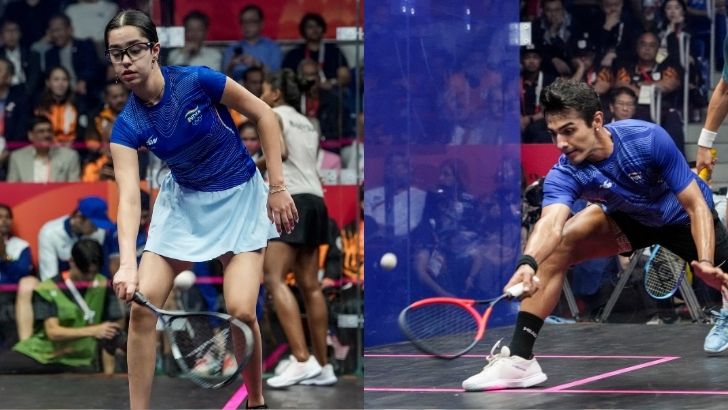
India's long wait for an individual squash gold at the Asian Games stretched on Sunday as young guns Anahat Singh and Abhay Singh were outplayed by seasoned Malaysian opponents and settled for silver medals after straight-game defeats.
On a rain-soaked day that added to the gloom around the Indian camp, Abhay, ranked 24th in the world, found defending champion Ng Eain Yow a class apart as the Malaysian produced a controlled, tactically astute performance to win 11-9, 11-5, 11-5 in 44 minutes.
Anahat, 18, had an equally frustrating afternoon, going down 4-11, 4-11, 7-11 against Malaysia's world No. 5 and defending champion Sivasangari Subramaniam in just 27 minutes.
The result means that both Anahat and Abhay missed out on securing berths for 2028 Los Angeles Olympics, where the game will make debut. The Indians will now have to look for other route.
No Indian has won an individual Asian Games gold in the sport. Saurav Ghosal also came close twice but he too had to be content with silver at Incheon in 2014 and Hangzhou in 2023.
Abhay had arrived in the final with confidence after an emphatic semifinal win over Pakistan’s Nasir Iqbal, but Eain Yow presented a completely different challenge.
The Malaysian, who beat Ghosal in the Hangzhou final three years ago, controlled the tempo, dictated the length and repeatedly dragged Abhay into uncomfortable corners.
The Indian had his chances in a fiercely contested opening game but could not convert the pressure into a lead.
Eain Yow repeatedly pinned him deep on the left side, forcing him into awkward retrievals, while a string of unforced errors, obstruction calls and a couple of costly tins kept the Malaysian ahead.
At 9-10, Eain Yow produced the decisive passage of play, working the ball into the difficult left-hand corner. Abhay could not extract enough from the retrieval and the Malaysian pocketed the game after a 21-minute battle.
The contest tilted sharply after that. Eain Yow tightened his lines along the side walls, denied Abhay the width to open up the court and maintained impeccable length. Whenever Abhay managed to apply pressure, the Malaysian absorbed it patiently before changing the pace with a deft drop or boast.
The result was a familiar squash pattern: Abhay was forced to cover increasingly more court, his retrievals became more desperate and the errors began to flow.
"I'm disappointed with today, but respect to my opponent. He was better than me today and deserved the win. He played well in every aspect of the game. His experience came in handy. He’s played in an Asian Games final before, so I think that made a bit of a difference," Abhay said.
For Abhay, the defeat was also a lesson in handling the biggest moments.
"His composure in big matches is something to learn from. Every win or loss is a lesson to take back home, and that’s exactly what I’ll be doing."
The Indian felt Eain Yow's relentless pressure eventually told.
"He was playing the better squash and put more work into me. It started paying off for him after a few points."
Abhay, however, has little time to dwell on the disappointment, with the race for qualification for the Los Angeles Olympics still on his radar.
"It's a bit tough to say much at the moment, but there’s still another shot at the spot. Hopefully, things will fall into place, and I’ll be able to get it,” he said.
For Abhay, the silver came with an especially painful rider -- a gold would have meant an automatic ticket to Los Angeles, where squash will make its Olympic debut in 2028.
"I'm just going to go back to the drawing board with my team, and we’ll see what we can do.”
Anahat, meanwhile, ran into an opponent who simply refused to allow her into the match.
The 18-year-old junior world champion and world No. 17 has rapidly established herself as one of the faces of Indian squash’s next generation, but against the 27-year-old Sivasangari she struggled to impose the attacking game and retrieving intensity that have powered her rise.
Sivasangari varied the pace superbly, kept her length tight and repeatedly changed the point construction before Anahat could settle into a rhythm.
The Malaysian surged 9-3 ahead in the opening game, with Anahat repeatedly being penalised for interference as she struggled to find the right court position.
The second game followed a similar pattern, with Sivasangari taking control early and forcing Anahat into hurried decisions. The Indian simply could not create the open court she needed to unleash her attacking strokes.
The third game finally offered a glimpse of resistance. Anahat stayed with Sivasangari for longer stretches and looked more comfortable, but the Malaysian tightened her length when it mattered and refused to give the Indian a way back.
For Anahat, the silver nevertheless marked another significant step in a rapidly accelerating career.
She has already moved into the world’s top 20 and is increasingly being spoken of as the next standard-bearer of Indian women’s squash after stalwarts such as Dipika Pallikal and Joshna Chinappa.
Share Now

Leave a Reply
Your email address will not be published. Required fields are marked *
Other Stories
.jpg)

.png)
.jpg)